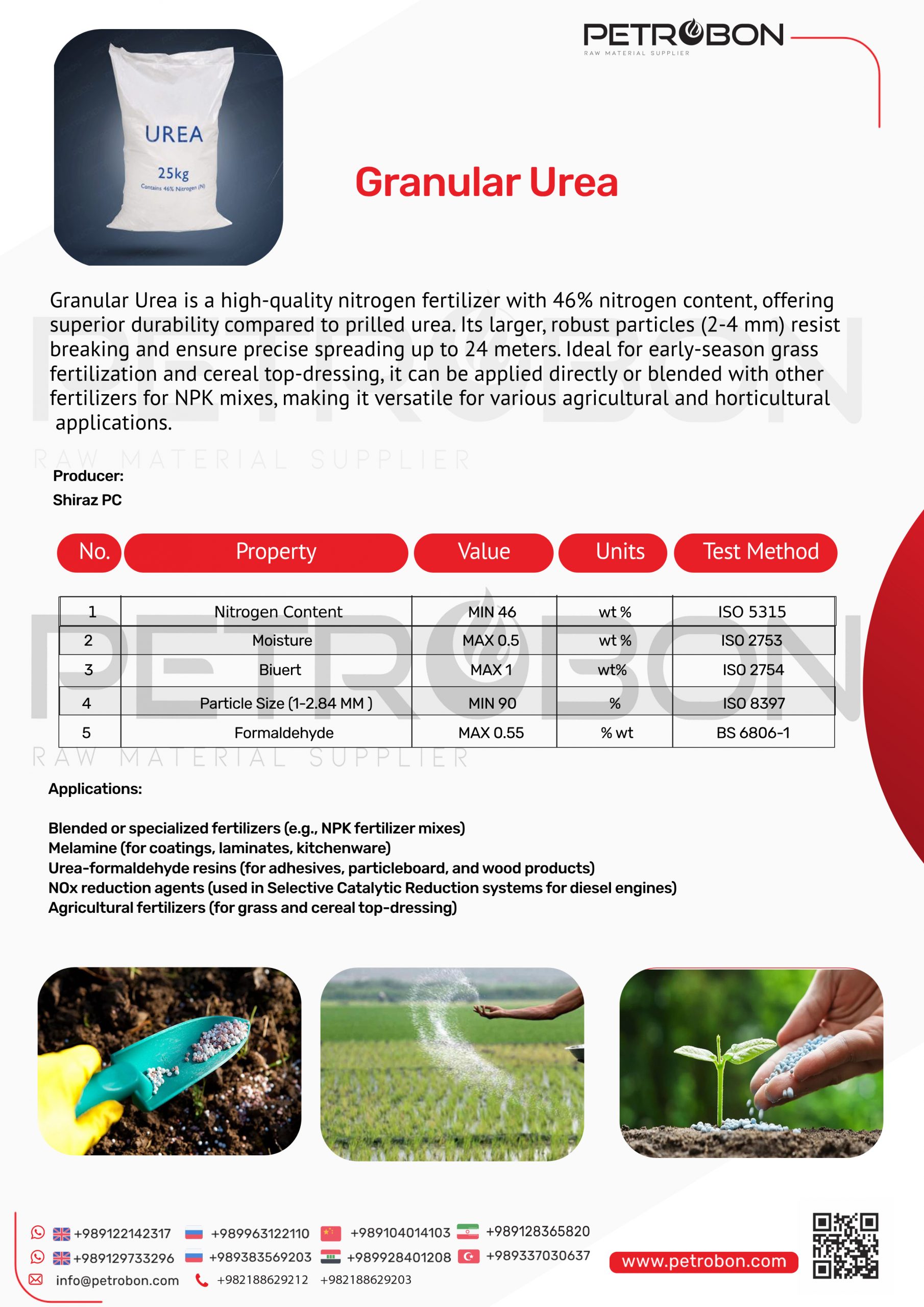
Global oil prices are variable, meaning there is no stable and specific price for Technical grade granule urea Please contact us to inquire about the daily prices. You can also find price changes of this material in the chart provided in this section.
Price Inquiry

.jpg)
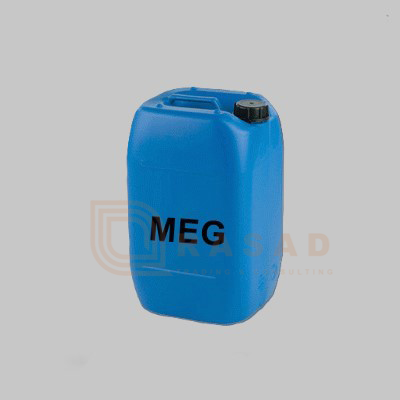
Ethylene glycol, also known as monoethylene glycol or MEG, is an odorless, colorless, flammable, hygroscopic liquid that is toxic in its high concentrations. It is the simplest combination of glycols and one of the most common organic compounds with the formula of C2H6O2. It can be gained from the reaction of ethylene oxide and water. Not only does it have low volatility and low viscosity, but it is also completely miscible with water and many other organic liquids like alcohols, aldehydes, ketones, and esters. This sweet-taste chemical can be mixed with water in any proportion. MEG is commonly used as a raw material for antifreeze fluids. Furthermore, the high boiling point of ethylene glycol and its strong affinity for water make it an ideal dehydrating agent for natural gas production.
There is a strong global need for Monoethylene Glycol as it is a vital ingredient. Due to the reactivity of the hydroxyl group and its high degree of solubility, ethylene glycol offers a wide range of applications. The ability to mix readily and form stable solutions enhances MEG’s versatility, efficiency, and effectiveness in numerous processes.
MEG is a key component in synthesizing polyester fibers, films, and resins. It is used to produce polyethylene terephthalate (PET) for plastic bottles and packaging. Polyester fibers, threads, films, and polyester resins are produced from the reaction between MEG with dibasic acids and their esters and it is used in the synthesis of PET.
It is used in synthesizing unsaturated polyester resins, alkyd resins, rosin esters, and polyurethane resins. It acts as a coalescence and anti-freezing agent in emulsified resins. It is used together with adipic acid and other glycols, and rubber with a high chemical and abrasion resistance. Resins produced from oleic acid and MEG, known as alkyd resins, are used frequently in the industry of paints and varnishes. It also can be used as a wetting and plasticizing agent in the production of cellophane, glues and adhesives, textiles, printing ink, leather, cosmetics, paper, and pharmaceutical products.
Because of its low freezing point, it can decrease the freezing point of water in automotive antifreeze. So, it is used in aircraft de-icing and anti-icing agents. Plus, it is used in industrial refrigeration circuits and internal combustion engine coolant systems to raise the boiling point and reduce the freezing point of the solution used. It can also be utilized in the formulation of printing ink, in the treatment of gases, in the formulation of fire-resistant hydraulic fluids, cutting oils, surface polishers, agrochemicals, extraction of solvents, manufacture of pigmented pastes and putty for walls, and in the synthesis of explosives.
MEG is a component in polyester fiber synthesis for sports and casual wear. It is used as a wetting and plasticizing agent in textile production. Polyester fibers have high strength, durability, and resistance to shrinking and wrinkling.
MEG is a key ingredient in polyethylene terephthalate (PET) production for making bottles, containers, films, and trays. PET has excellent transparency, mechanical strength, and recyclability.
It serves as a raw material, solvent, plasticizer, humectant, and intermediate in various chemical syntheses. MEG is also used to produce unsaturated polyester resins, polyurethane systems, detergents, morpholine, and other organic compounds.
MEG acts as a dehydration agent in natural gas pipelines. It can inhibit the formation of natural gas clathrates.
It is used as a lubricant for moving parts in cooling systems and as an additive for electrolytic polishing belts, besides antifreeze.
It can be applied as a de-icing and anti-icing agent for aircraft. It leads to preventing ice formation on the wings, fuselage, and other parts of the aircraft.
Melamine crystal is a white powder with the chemical formula C3H6N6. Melamine crystal, also known as melamine, is an organic compound with an ammonia-like odor.
.jpeg)